Why governments say stockpile for 72 hours
Since 2024 the EU and six European governments have asked households to be able to manage without help at the start of a crisis: 72 hours in most countries, a week or more in some. These are all-hazards campaigns covering events such as power cuts, floods, cyber attacks and conflict; they are not warnings that a nuclear attack is coming.
Below is what each one said, in its own words, with a link to the original. We make no prediction about any threat. This page is general information, and your own national and local authorities' instructions come first.
What did each government actually say?
European Union, October 2026. The Commission's non-binding guidelines ask civil-protection authorities to "promote at least 72 hours of self-sufficiency as a minimum baseline". Source: Commission communication C(2026) 8250.
United Kingdom, 22 October 2026. The Cabinet Office launched Be Ready, with "the advice to be prepared for three days of disruption" at its heart. Its checklist includes "Bottled water for 3 days" and "Non-perishable food for 3 days". Source: GOV.UK.
France, 20 November 2025. The government guide Tous responsables recommends an emergency kit, kept within reach, giving everyone "72 heures d'autonomie", meaning 72 hours of self-sufficiency. Source: info.gouv.fr.
Netherlands, 17 November 2025. The government announced a booklet for more than 8.5 million households, so that people can manage "de eerste 72 uur", the first 72 hours. Source: Rijksoverheid.
Germany, October 2025. The federal civil-protection office BBK reissued its household guide. Its advice is to be able to supply yourself for "möglichst zehn Tage", ideally ten days, and it says even "zumindest drei Tage", at least three days, helps a great deal. Source: BBK.
Sweden, November 2024. The brochure In case of crisis or war went out to households. The civil-defence agency's standard is "being able to manage on one's own for at least a week". Source: Swedish Civil Defence and Resilience Agency.
Norway, May 2024. The civil-protection directorate DSB raised its advice "from at least three days to one week", then posted a brochure to every household. Source: DSB.
How long does each one ask for?
| Who | When | Period |
|---|---|---|
| European Union | October 2026 | At least 72 hours, as a minimum baseline |
| United Kingdom | October 2026 | Three days |
| France | November 2025 | 72 hours |
| Netherlands | November 2025 | The first 72 hours |
| Germany | October 2025 | Ideally ten days, at least three |
| Sweden | November 2024 | At least a week |
| Norway | May 2024 | One week |
Is this a warning about nuclear war?
No. These are all-hazards campaigns, and none of the statements quoted above is a warning of a nuclear attack.
The Commission's own guidance describes preparedness as "a precautionary measure based on a changing risk environment, not a response to a specific or immediate threat". We take the same view.
Why 72 hours?
In the documents quoted here, 72 hours is a floor rather than a target. The Commission calls it "a minimum baseline", and Germany, Sweden and Norway ask for more.
As we read them, the campaigns share one principle: in the first days of a crisis, help goes to the people in greatest need, and everyone else looks after themselves for a while.
What does 72 hours of self-sufficiency look like at home?
The UK checklist names bottled water and non-perishable food for three days. US guidance that our book draws on is more specific: Ready.gov and the American Red Cross use one gallon (about 4 litres) of water per person per day, and the Red Cross recommends three days of supplies in an evacuation kit and two weeks at home.
A complete three-day list is in our 72-hour emergency kit checklist.
Where does a nuclear emergency fit in?
It is the hardest scenario, and one a household leaflet has little room for. Official US guidance for a nuclear detonation is to get inside a solid building and stay there for at least 24 hours. Most of what that takes is ordinary emergency supplies.
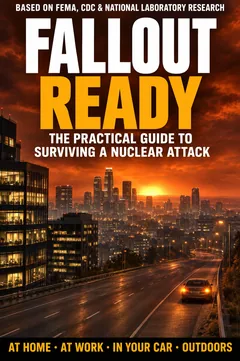
Our book Fallout Ready works through that scenario in practical detail. No government asked for it and none endorses it. Its lists are summarised in the nuclear survival kit list, and the actions in how to survive a nuclear attack.
Sources
- European Commission communication C(2026) 8250
- European Commission communication C(2026) 8250, addendum 2
- GOV.UK: Households encouraged to take small, simple steps to stay prepared in an emergency
- info.gouv.fr: Tous responsables
- Rijksoverheid: information booklet announcement, 17 November 2025
- BBK: Bevorraten
- Swedish Civil Defence and Resilience Agency: Home preparedness
- DSB: Self-preparedness
- Ready.gov: Build a Kit
- American Red Cross: Survival Kit Supplies
Questions
Why do governments recommend a 72-hour emergency kit?
The EU and several European governments ask households to be able to cope alone at the start of a crisis, such as a long power cut or a flood. The European Commission asks authorities to "promote at least 72 hours of self-sufficiency as a minimum baseline", and the UK, France and the Netherlands use the same three-day figure.
Is the EU telling people to prepare for nuclear war?
No. The guidance is all-hazards, covering events such as power cuts, floods, cyber attacks and conflict. The Commission's own text describes preparedness as "a precautionary measure based on a changing risk environment, not a response to a specific or immediate threat".
Which countries recommend stockpiling for 72 hours?
The UK, France and the Netherlands each advise three days or 72 hours, and the EU sets 72 hours as a minimum baseline. Germany's civil-protection office advises ideally ten days and at least three. Sweden and Norway both advise at least a week.
Are the EU's 72-hour guidelines mandatory?
No. The European Commission's guidelines are non-binding. They ask civil-protection authorities to promote at least 72 hours of household self-sufficiency as a minimum baseline.